Quick start Guide
[Page under construction]
Please contact winslow@fableforestry.com for direct support
Welcome!
Thank you for joining Naughtweed, and for caring enough about our shared lands and waters to act on what you see out there. Getting started takes about five minutes, and you won't need any technical background.
Your button is the simplest part of this system by design. One press logs a detection. That's it. The guide below walks you through pairing your button with your phone, right through encoding your first data point - so that when you spot something in the field, you're ready.
Once you're set up, every press you make becomes part of a shared Early Detection network - helping land managers and community scientists respond faster, together. We’re cooking on making these data actionable through a task management add-on; stay tuned for that!
Glad to have you with us,
Winslow Robinson, PhD
Founder, Fable Forestry
c: 603-770-6038
0. The context for this work
The existing landscape of early detection tools has made real contributions to invasive species tracking. Platforms like iMapInvasives, EDDMapS, and iNaturalist have built substantial observational databases by engaging volunteers and land managers in structured reporting. Each requires the observer to stop, open an app, navigate a form, identify a species with some confidence, and submit a record - a workflow well suited to dedicated naturalists and trained monitors, but one that creates meaningful friction for the citizen scientist who simply notices the same suspicious plant each day during their commute.
Naughtweed is built around a different assumption: that detection capacity scales when the barrier to logging an observation approaches zero. Rather than asking users to become ‘citizen scientists’, it asks them to do one thing - press a button - at the moment of recognition, without stopping, without a form, and without requiring species-level confidence at the point of capture. The result is a different kind of dataset: initially lower in taxonomic precision per record, but dramatically higher in geographic coverage and temporal density, captured by people moving through the landscape in the course of ordinary life. Where traditional EDRR platforms optimize for data quality per observation, Naughtweed optimizes for observation frequency - and treats the network of everyday travelers as the detection infrastructure itself.
We address this precision gap through what we’re calling Visual Peer Review - a layer built directly into the workflow. When overlapping observations are logged, the group is essentially voting by tagged overlaps. These ‘visual votes’ accumulate spatially, and as agreement builds, so does the observation's confidence score. Confidence thresholds are configurable by state or regional partners based on their management priorities: a state with active knotweed response protocols might require 8 of 10 confirming votes to elevate a record to actionable status, while a jurisdiction in early surveillance mode might set that bar lower to cast a wider net. When an observation clears its threshold, its status is elevated in the system - flagged for land managers, prioritized for ground-truthing, and surfaced in reporting dashboards. It's a model borrowed from the logic of distributed consensus: no single observer needs to be an expert, but ten observers agreeing on what they saw is something a land manager can act on.
Free button? Say less.
Subscribe for one year, and we’ll mail your first button for free!
[purchase link here]
1. Setting up your buttons
Link button to phone
Enable location services within Flic
IFTTT setup
2. Linking your button to Google Sheets
Log into demo Naughtweed account
link to our Google Sheet
Use the following recipe
3. Data collection
single press
Long press
Changing what you’re collecting (species, potholes, or anything else)
4. Tips and tricks
density observations
one-time observations
undo
FAQ
Can this be set up to work with iNaturalist and / or EDDMaps?
Is there an ‘undo’ function if someone gets button-happy?
If you are monitoring multiple species, how do you switch from one to the next?
Curious also about whether location uncertainty would be recorded based on device specs!
What folks are saying…
“I used to do some community science monitoring with a lot of seniors in rural VT and many of those groups don't have smartphones at all, so being able to hand out Garmins is nice - but they are not so easy to use as this could be.”
“A lot of my work and others is in the middle of the forest, and i can't always download whole maps and datasets on my phone due to space.”
“This seems really great for community science - but I've struggled with phone-based data/GPS tools in areas where many people don't have cellphone or cell coverage. Is there a physical hardware option? Also, is it easy to correct accidental button-presses?”
“Understanding the quality of this data would be important for me as a researcher. Geographic accuracy, plant ID, and bias in where data are collected. Probably a function of the user and focal species.”
“We need this on railways to look for tree of heaven”
We can’t wait to see how you contribute to these maps.
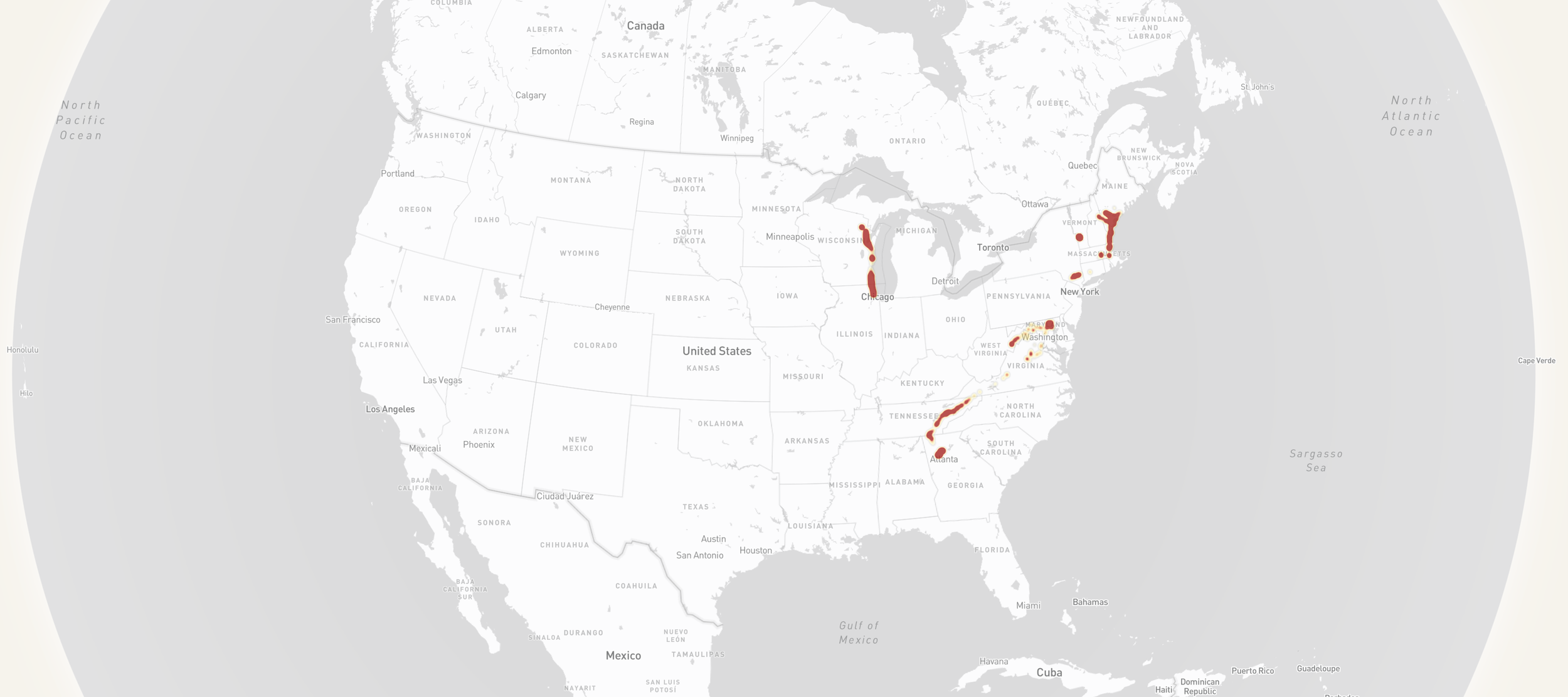
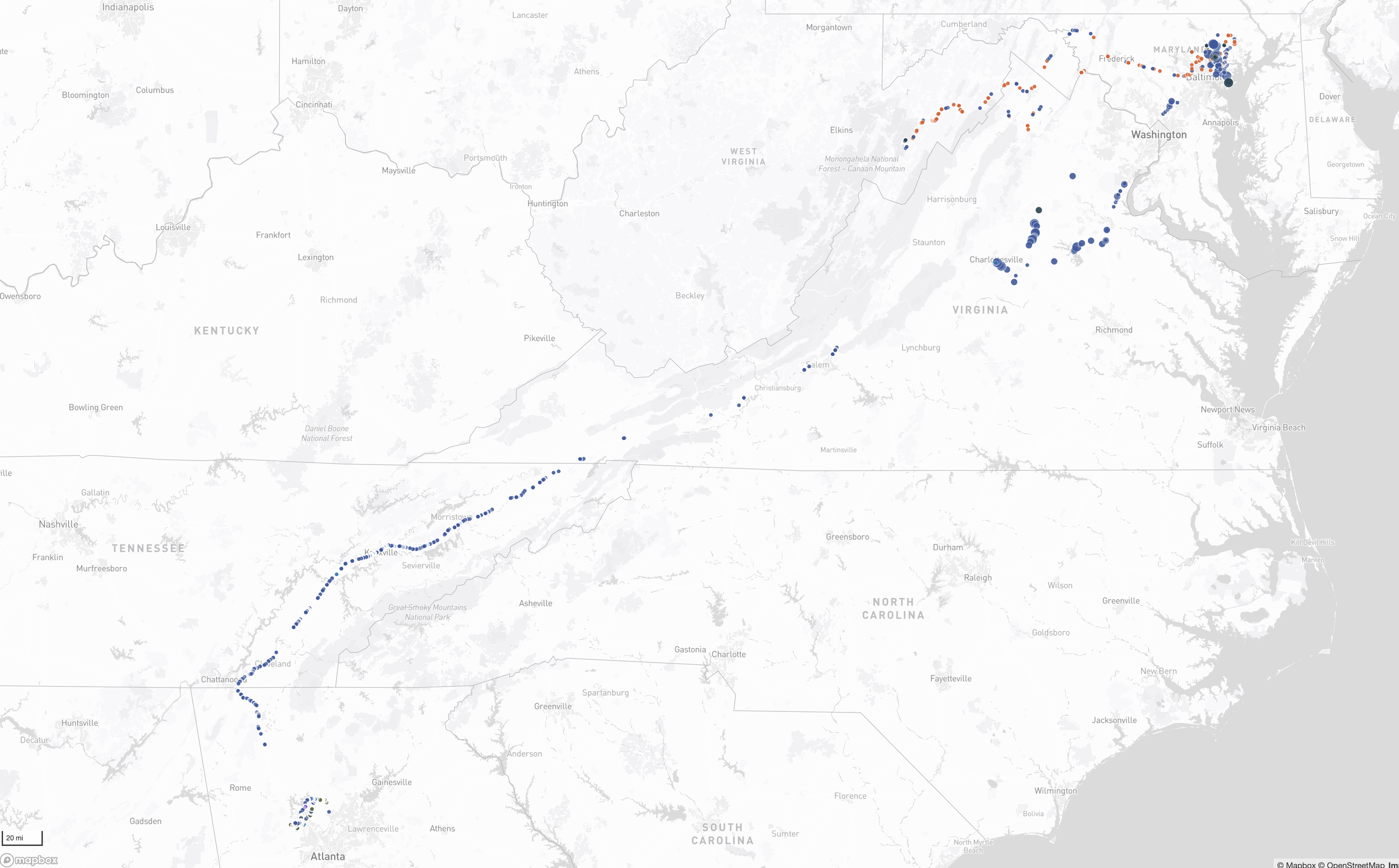
The interactive map below shows confirmed detections of two of the Northeast's most aggressive aquatic and riparian invasives: Japanese knotweed and common phragmites. Yellow-to-orange clusters indicate knotweed pressure, concentrated heavily along river corridors in Maine and New Hampshire. Blue indicates phragmites density, visible in high-intensity patches near the coast and along major wetland systems south of Augusta.
The corridor pattern isn't coincidental — both species disperse along waterways, making rivers both the problem and the map's organizing logic. Where you see overlap, you're looking at sites where management complexity compounds: two species, one location, competing removal timelines.
What makes this dataset unusual is how it was built. None of these observations were collected during dedicated field surveys or structured monitoring windows. Every data point represents a single button press — made by someone already on the road. On the way to work. Dropping a kid off at school. Taking the dog to the vet. Passing a familiar roadside patch for the hundredth time and finally having a way to say something's there.
That's the premise behind Naughtweed: that the people most likely to notice invasive pressure are the ones who already move through the landscape every day. The data doesn't require a field crew or a grant-funded survey window — it requires a button within reach and a moment of recognition. What you're looking at is what distributed, low-friction citizen detection actually looks like at scale across a region.